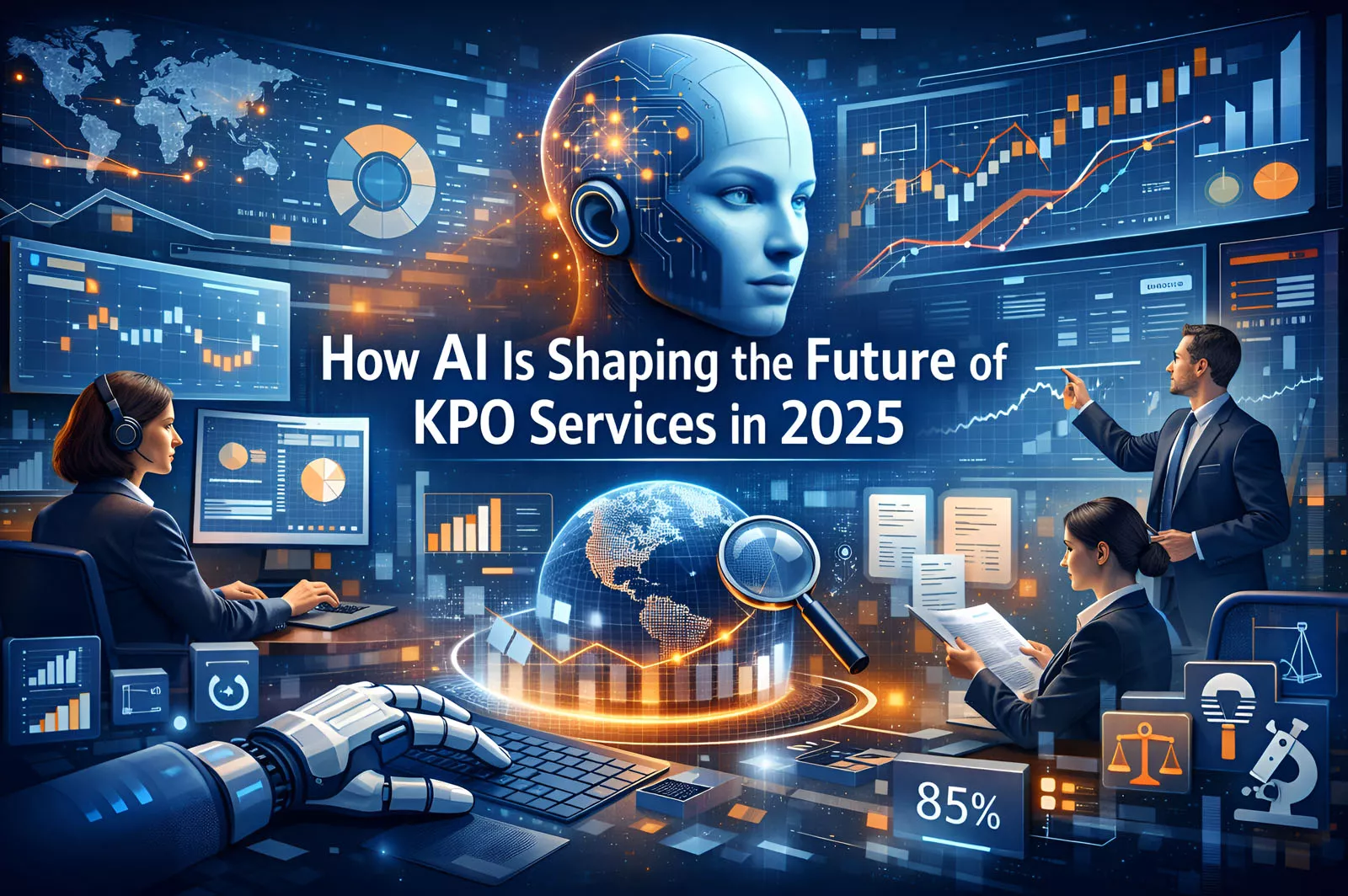
How AI Is Shaping the Future of KPO Services in 2025
Knowledge Process Outsourcing, or KPO, has always been about depth. Unlike traditional outsourcing, it deals with high-value work such as research, analytics, financial modeling, legal services, and domain-specific consulting. In 2025, artificial intelligence is no longer just supporting this work. It is actively reshaping how KPO services are delivered, priced, and valued.
This shift is not about replacing experts. It is about amplifying their capabilities and changing expectations across industries.
From Manual Expertise to AI-Enhanced Intelligence
KPO firms have historically relied on skilled professionals with advanced degrees and years of experience. That foundation still matters, but AI now handles many of the repetitive and time-consuming parts of knowledge work.
Tasks like data collection, document review, trend scanning, and preliminary analysis can be completed in minutes instead of days. This allows human experts to focus on interpretation, strategy, and decision-making, where context and judgment matter most.
The result is not less expertise, but better use of it.
Faster Insights Without Cutting Corners
Speed has become a major differentiator in KPO services. In 2025, clients expect insights quickly, without sacrificing quality. AI helps make that possible.
Machine learning models can analyze massive datasets, identify patterns, and flag anomalies far faster than manual methods. In market research, for example, AI can process customer sentiment across thousands of sources and surface meaningful insights almost instantly.
Human analysts then validate those findings, add industry context, and translate them into actionable recommendations. The workflow becomes collaborative rather than sequential.
Personalization at Scale
One of the most noticeable changes in KPO is how tailored the output has become. AI enables firms to customize reports, forecasts, and recommendations for different clients, industries, or regions without starting from scratch each time.
Financial KPO teams use AI-driven models that adapt to a client’s risk appetite, regulatory environment, and market exposure. Legal research teams rely on AI to surface case law that is relevant not just broadly, but to a specific jurisdiction or business scenario.
This level of personalization used to be expensive and slow. Now it is becoming the standard.
Better Decision Support, Not Just Better Reports
Traditional KPO often focused on delivering reports and analyses. In 2025, the emphasis has shifted toward decision support.
AI-powered KPO services simulate scenarios, predict outcomes, and test assumptions. Whether it is forecasting supply chain risks or evaluating investment strategies, AI helps decision-makers see potential futures rather than static snapshots of the past.
This makes KPO providers more strategic partners than service vendors. Clients are no longer asking only for data. They are asking what the data means and what to do next.
Managing Risk and Compliance More Proactively
Risk management is another area where AI is changing the game. In sectors like finance, healthcare, and energy, compliance requirements evolve constantly. AI systems monitor regulatory updates, flag potential issues, and assess exposure in real time.
KPO teams then step in to interpret these signals, assess impact, and recommend actions. This proactive approach reduces surprises and helps organizations stay ahead of compliance challenges instead of reacting after the fact.
The Human Element Still Matters
Despite all the advances, AI does not replace human judgment, creativity, or ethical reasoning. In fact, as AI takes on more analytical work, the human side of KPO becomes even more important.
Clients value professionals who can challenge assumptions, explain complex findings clearly, and understand the nuances of their business. The most successful KPO firms in 2025 are those that combine strong AI capabilities with experienced domain experts who know how to use them wisely.
What the Future Looks Like
Looking ahead, AI will continue to blur the lines between consulting, analytics, and outsourcing. KPO services will become more integrated into core business decision-making, not treated as back-office support.
Firms that invest in responsible AI, continuous upskilling, and transparent processes will stand out. Those that rely on AI without human oversight, or cling to old manual models, will struggle to keep up.
In 2025, the future of KPO is not about choosing between humans and AI. It is about building systems where each does what they do best.
Related to this topic:
How Generative AI Is Changing Knowledge Process Outsourcing

The Role of Data Analytics in Modern KPO Operations