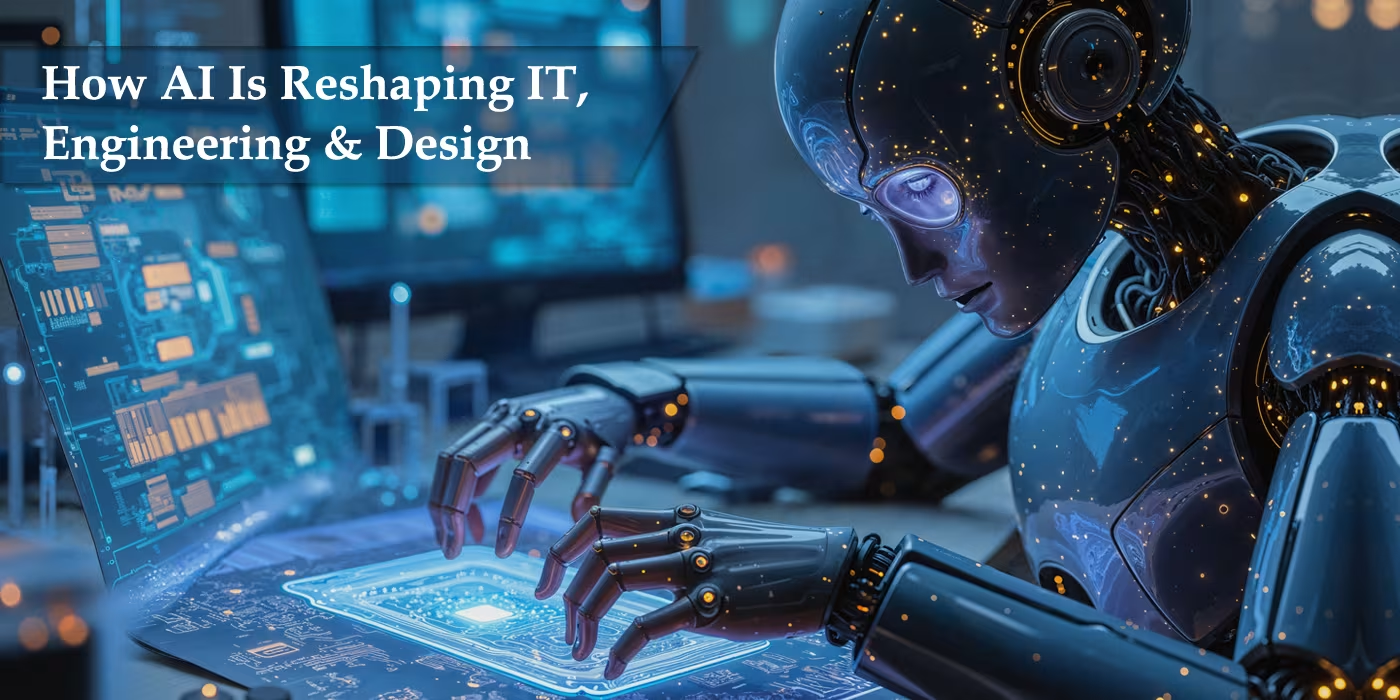
How AI Is Reshaping IT, Engineering & Design — Real Impacts and What Comes Next
Introduction
I remember watching an early prototype of an AI tool finish a week’s worth of routine bug triage in under an hour — it felt like watching a new colleague arrive. That moment captures the larger shift: AI isn’t a sci‑fi replacement for human work, it’s a capability multiplier that’s quietly rewriting how teams build, protect and craft products. This article explains the concrete ways AI is changing three connected fields — IT, engineering and design — and gives practical guidance for organizations and professionals navigating the change.
The AI landscape today — core technologies and why they matter
AI now blends several mature capabilities: machine learning for prediction, natural language processing for understanding and generation, computer vision for perception, and generative AI for creative outputs. Together they enable automation (from code suggestions to defect detection), deeper insight (predictive analytics, anomaly detection) and new creative workflows (generative visuals, layout suggestions). These building blocks are what businesses plug into their stack to speed decisions and reduce repetitive work.
AI in Information Technology — faster, safer, smarter operations
- Smarter software development: AI coding assistants suggest idiomatic snippets, auto‑generate tests and flag security anti‑patterns, helping developers ship cleaner code faster. Use case: a CI pipeline that auto‑generates unit tests for new modules, cutting manual test creation time significantly.
- AI‑powered cybersecurity: Machine learning models identify abnormal network patterns, prioritize threats and even suggest automated containment actions; this reduces mean time to detect and remediate incidents.
- Intelligent IT support: Conversational agents handle tier‑1 incidents, surface relevant KB articles and escalate only when human judgement is essential, which improves response times and lets engineers focus on higher‑value problems.
- Predictive operations: AI analyzes logs, metrics and device telemetry to predict outages and recommend preventative fixes — transforming maintenance from reactive to proactive.
Tip for IT leaders: Start small with high‑value automation — incident classification, alert deduplication, or automated remediation playbooks — then measure MTTR and operational cost savings.
AI in Engineering — from conceptual designs to reliable systems
- Generative and optimization tools: Engineers use AI to propose design variants that optimize for weight, cost or thermal performance, accelerating concept exploration and reducing time to a viable prototype.
- Predictive maintenance and digital twins: Combining sensor data with AI models enables accurate equipment health forecasts and virtual testing through digital twins, which saves downtime and extends asset life.
- Simulation acceleration: Surrogate models speed up complex physics simulations (CFD, FEA), letting teams iterate designs more frequently and test edge cases without prohibitive compute costs.
- Systems engineering with AI: AI assists in requirements traceability, anomaly detection in complex systems and automated verification, improving overall reliability.
Example: An automotive OEM used AI‑guided simulation to pare down a structural component’s mass by 12% while preserving safety margins, shortening the iteration cycle by weeks.
AI in Design & Creative Workflows — augmentation, not replacement
- Generative design and ideation: Designers use AI to rapidly generate layout options, color palettes or initial asset drafts, which frees creative time for strategy and refinement.
- UX personalization: Real‑time behavioral models tailor interfaces and micro‑interactions to individual users, increasing engagement and conversion when used ethically.
- Content creation and multimedia: AI speeds up routine tasks like background removal, rough-cut video editing, and asset resizing, allowing agencies to scale production without proportionally increasing headcount.
- Research and accessibility: AI analyzes user sessions to highlight friction points, and suggests accessibility fixes (contrast, ARIA attributes) that improve inclusivity.
Practical design practice: Use AI for rapid prototyping and A/B hypothesis generation, but retain human oversight for final aesthetic decisions, ethics and cultural fit.
Cross‑cutting benefits — speed, accuracy and new business models
- Speed: Faster prototyping, shorter feedback cycles and automated testing shrink time‑to‑market.
- Accuracy: Automated checks (security, compliance, accessibility) reduce human error and support consistent quality.
- Cost efficiency: Routine work automates away, letting teams repurpose effort toward innovation.
- New services: Outcome‑based contracts, AI‑enabled managed services and predictive SLAs become viable commercial models.
Real challenges — what leaders must not ignore
- Data quality and privacy: AI is only as good as the data it sees; poor telemetry or biased datasets produce poor outcomes. Data governance and anonymization matter.
- Skills gap and role redesign: New roles (ML‑ops, AI explainability specialist, data‑centric engineers) are needed; continuous upskilling is essential.
- Ethical and legal risk: Bias, copyright issues with generative models, and regulatory uncertainty require explicit policies and human review loops.
- Overautomation trap: Automating tasks without considering human oversight can create brittle processes and hidden failure modes.
Actionable mitigation: Implement AI governance (model cards, audit trails, KPIs), require human‑in‑the‑loop checks for risky decisions, and invest in targeted reskilling programs.
People and careers — how roles are evolving
- Hybrid expertise wins: Engineers who understand ML pipelines, designers who can prototype with AI tools, and IT pros fluent in observability and automation are in high demand.
- Move from execution to orchestration: More time will be spent on system design, ethics review, and integrating AI outputs rather than performing repetitive tasks.
- Career advice: Build a portfolio that shows how you used AI to deliver measurable outcomes (reduced MTTR, increased conversion, lower material cost), and combine technical depth with domain context.
Practical playbook for organizations (6 steps)
- Identify high‑value, low‑risk pilots (incident triage, asset monitoring).
- Audit data readiness and privacy constraints.
- Choose modular tools — prefer models that integrate with your CI/CD and design systems.
- Define KPIs and guardrails (MTTR, false positive rate, fairness metrics).
- Run short sprints with human oversight and document learnings.
- Scale what shows quantifiable value and embed governance.
People Also Ask (optimized for snippets and voice)
- Will AI replace designers, engineers or IT people?
No — AI automates repetitive tasks and augments decision‑making; humans remain vital for creativity, systems thinking and ethical judgement. - Which IT jobs are most affected by AI?
Routine support, basic code generation and ticket triage face the most automation, while roles involving architecture, security and strategic planning are less affected. - What skills should engineers learn for an AI future?
Learn ML fundamentals, data engineering basics, model evaluation, and cloud‑native deployment patterns (ML‑ops). - How can designers use AI ethically?
Keep human review, attribute sources for generated assets when required, and test for cultural bias and accessibility.
Real-world examples (short case studies)
- DevOps automation: A SaaS firm reduced deployment rollbacks by automating canary analysis using ML models trained on historical metrics.
- Manufacturing: A plant implemented predictive maintenance that cut unplanned downtime by 35% using sensor fusion and time‑series forecasting.
- Design agency: An agency used generative tools to produce dozens of advertising concepts; human curators selected and refined the strongest ideas, improving campaign A/B performance.
The next five years — likely trends
- More explainable AI in production with mandatory documentation and audit trails.
- Wider adoption of AI for systems‑level engineering (digital twins, model‑based systems engineering).
- Creative tooling that tightly integrates with design systems and brand governance.
- Regulation that balances innovation with accountability, pushing organizations to adopt stronger governance practices.
FAQ — concise, voice‑search friendly
Q: How does AI improve software security?
A: AI detects anomalies, automates threat triage and suggests remediation steps, reducing detection time and false negatives when combined with expert review.
Q: Can AI design complete products?
A: AI can accelerate ideation and generate variants, but human designers set strategy, ensure cultural fit and finalize decisions.
Q: What’s the fastest way to learn AI skills for engineers?
A: Focus on project‑based learning — a small end‑to‑end ML project (data ingestion to model deployment) plus courses on ML fundamentals and ML‑ops.
Q: Should companies buy AI tools or build models in‑house?
A: Start with off‑the‑shelf tools for quick wins and build proprietary models where differentiated data and long‑term value justify the investment.
Conclusion
AI is not a single disruptor — it’s a set of capabilities that reshapes workflows, raises the bar for measurable outcomes, and creates new hybrid roles. Organizations that treat AI as a partnership (not a black box), invest in data and people, and prioritize ethical guardrails will unlock the greatest long‑term value. For professionals, the opportunity is to raise your scope from execution to orchestration: craft the questions AI answers, validate its outputs, and apply human judgement where it counts.