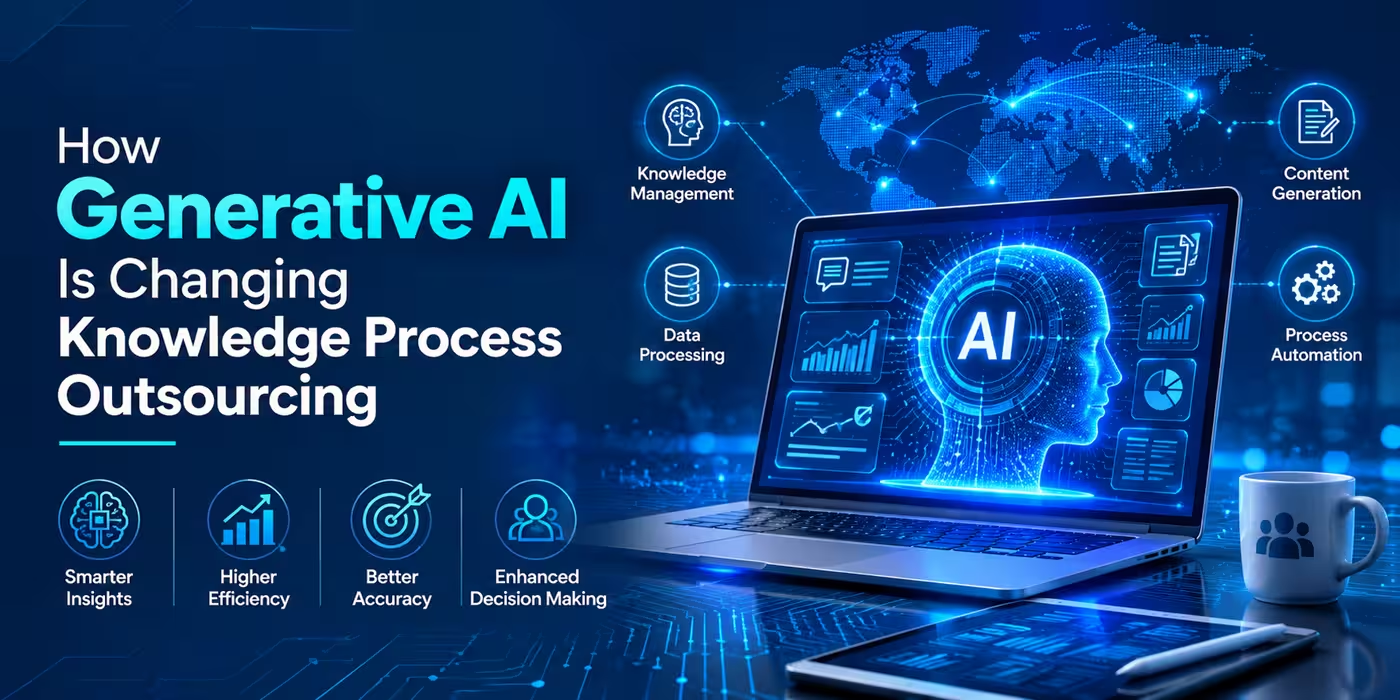
How Generative AI Is Changing Knowledge Process Outsourcing
Generative AI is changing Knowledge Process Outsourcing (KPO) from a labor-intensive service model into a technology-enabled system for research, analysis, decision support, and expert collaboration. It is helping KPO providers process more information, deliver insights faster, and create higher-value services—while also raising difficult questions about accuracy, privacy, intellectual property, and the future of specialist work.
For years, KPO firms have supported businesses with activities that require more than routine administration. Their teams interpret financial data, conduct market research, review legal documents, analyze healthcare information, prepare reports, and support strategic decisions.
Now, generative AI is entering almost every stage of that workflow.
An analyst may begin the day by asking an AI system to compare thousands of documents, identify emerging themes, draft a research summary, or convert complex data into a client-ready presentation. The analyst’s role has not disappeared. Instead, the work is moving toward verification, interpretation, judgment, and communication.
That shift is the real story. Generative AI is not simply replacing knowledge workers. It is reshaping how knowledge is collected, checked, organized, and turned into business value.
Table of Contents
- What Is Knowledge Process Outsourcing?
- Why Generative AI Matters to KPO
- How Generative AI Is Changing KPO Workflows
- Major Applications of AI in KPO
- Benefits of Generative AI for KPO Providers
- Risks and Challenges of AI-Powered KPO
- The Changing Role of KPO Professionals
- How KPO Companies Can Adopt Generative AI
- The Future of Knowledge Process Outsourcing
- Frequently Asked Questions
- Conclusion
What Is Knowledge Process Outsourcing?
Knowledge Process Outsourcing is the practice of assigning specialized, research-driven, and analytical business functions to an external service provider.
Unlike traditional Business Process Outsourcing, which often focuses on repetitive and rules-based activities, KPO depends on subject-matter expertise. A KPO team may be expected to understand an industry, assess evidence, apply professional judgment, and produce recommendations.
Common KPO services include:
- Market and competitive intelligence.
- Investment research and financial analysis.
- Legal research and contract review.
- Healthcare and pharmaceutical research.
- Data analytics and business intelligence.
- Engineering and technical research.
- Tax, compliance, and risk analysis.
- Content research and editorial support.
- Patent research and intellectual property analysis.
- Corporate strategy and due diligence.
A financial research analyst, for example, may review company filings, earnings transcripts, industry reports, and economic indicators before preparing an investment brief. A legal research team may examine case law, statutes, contracts, and regulatory changes. A healthcare research specialist may compare clinical studies and summarize treatment developments.
These tasks require context. They cannot be handled safely by copying information from one place to another.
That is why the arrival of generative AI is especially significant for KPO. The technology can automate portions of research and drafting, but the value of the final service still depends on professional reasoning.
Why Generative AI Matters to KPO
Generative AI refers to artificial intelligence systems that create new content from instructions and source material. Depending on the application, these systems can generate text, summaries, software code, tables, images, presentations, and structured insights.
For KPO providers, the most important capabilities are not novelty or creativity. They are speed, scale, pattern recognition, and language processing.
A generative AI system can:
- Read and compare large volumes of text.
- Extract facts from unstructured documents.
- Summarize long reports.
- Classify information by topic or risk.
- Draft first versions of reports.
- Translate and localize content.
- Answer questions about an approved knowledge base.
- Identify relationships across multiple sources.
- Convert natural-language instructions into structured outputs.
The business case is becoming more credible as organizations move from experimentation toward practical use. McKinsey’s 2025 global AI research reported that 88% of respondents said their organizations used AI in at least one business function, although many companies were still struggling to scale these systems across the enterprise.
That gap between adoption and scale is particularly relevant to KPO. A provider may demonstrate an impressive AI pilot, but transforming the pilot into a reliable client service requires secure data pipelines, quality controls, skilled reviewers, workflow redesign, and clear accountability.
In other words, buying access to a large language model is easy. Building a trustworthy AI-enabled KPO operation is much harder.
How Generative AI Is Changing KPO Workflows
Generative AI is changing KPO at the workflow level rather than through one isolated application. It affects how teams receive assignments, conduct research, create deliverables, and respond to clients.
1. From manual research to AI-assisted discovery
Traditional research often begins with a researcher searching databases, opening documents, scanning pages, recording notes, and creating a source list.
Generative AI can accelerate the early stages by locating relevant passages, comparing documents, extracting recurring themes, and organizing evidence into a working structure. This does not eliminate research. It changes the researcher’s first task from “find everything” to “define what matters and verify what the system found.”
For example, a market intelligence team studying the electric vehicle sector might use an AI tool to compare:
- Competitor earnings calls.
- Government policy announcements.
- Battery technology filings.
- Consumer sentiment reports.
- Supply-chain risk disclosures.
- Regional sales data.
The system can produce an initial map of the subject. An experienced analyst then checks the sources, separates facts from assumptions, and explains what the evidence means for the client.
2. Faster document review
KPO teams often handle large collections of contracts, invoices, filings, medical papers, policy documents, or technical manuals.
Generative AI can support document intelligence by identifying clauses, extracting dates and obligations, comparing versions, and flagging unusual language. In legal outsourcing, for instance, an AI-assisted system might identify change-of-control provisions across hundreds of agreements.
The important distinction is between flagging and deciding.
AI can highlight a clause that deserves attention. A qualified lawyer or contract specialist must still determine whether the clause creates a material legal or commercial risk.
3. Automated first drafts
Report writing can consume a significant share of an analyst’s time. Generative AI can create a preliminary draft from approved data, research notes, templates, or internal knowledge bases.
A first draft might include:
- An executive summary.
- A timeline of events.
- A comparison table.
- A list of market developments.
- A risk-and-opportunity section.
- Suggested questions for further investigation.
This allows experts to spend more time improving the substance instead of starting with a blank page.
However, a first draft is not a final answer. The system may misunderstand a source, overstate a conclusion, repeat an outdated fact, or produce a confident but unsupported statement. Human review remains essential, particularly in finance, healthcare, legal services, and compliance.
4. Conversational knowledge access
Many KPO organizations hold valuable knowledge in research repositories, standard operating procedures, client files, and past deliverables. Historically, finding that information depended on a specialist knowing where to look.
A secure retrieval-augmented generation system can allow authorized users to ask questions in ordinary language and receive answers grounded in approved documents. This approach can make internal knowledge easier to access without requiring the model to rely only on general web data.
A research manager might ask:
“Which sources support the conclusion that pricing pressure increased in the European market during the last two quarters?”
A well-designed system should return the answer alongside citations, document names, dates, and relevant passages. This makes the result easier to audit and improves trust.
5. Continuous rather than periodic analysis
Many outsourced research services have traditionally operated on a scheduled basis: a weekly report, a monthly dashboard, or a quarterly review.
Generative AI makes continuous monitoring more practical. A system can watch approved sources for regulatory changes, competitor announcements, litigation developments, product launches, or market signals. It can then summarize relevant events and route them to a human reviewer.
This creates a more responsive KPO model. Instead of delivering only a report at the end of a cycle, the provider can offer an ongoing intelligence service.
Major Applications of AI in KPO
The impact of generative AI differs across KPO disciplines. Some tasks are highly suitable for automation, while others require close expert supervision.
Financial research and investment analysis
In financial KPO, generative AI can assist with:
- Earnings-call summaries.
- Financial statement extraction.
- Company and sector comparisons.
- Management commentary analysis.
- Research note drafting.
- Scenario-building support.
- News and filing monitoring.
- Portfolio reporting.
A human analyst can use AI to prepare a comparison of revenue growth, margins, debt levels, and management guidance across several companies. The analyst then validates the numbers, investigates inconsistencies, and develops the investment interpretation.
The opportunity is not merely faster reporting. It is the ability to cover more companies, markets, and information sources without expanding the team at the same rate.
Legal process outsourcing
Legal KPO providers can use generative AI for:
- Legal research assistance.
- Contract summarization.
- Clause comparison.
- Case chronology preparation.
- Due diligence support.
- Regulatory monitoring.
- Discovery document classification.
- Drafting routine correspondence.
Legal work requires a particularly strong review process because a misleading summary or missed clause can have serious consequences. AI should therefore operate within defined boundaries, with source traceability and qualified human approval.
Healthcare and life sciences research
Healthcare KPO teams support pharmaceutical companies, hospitals, insurers, and research organizations.
Potential applications include:
- Clinical-trial literature reviews.
- Medical information summarization.
- Pharmacovigilance workflow support.
- Patent and pipeline research.
- Regulatory document analysis.
- Scientific content drafting.
- Healthcare market intelligence.
In this field, the system must distinguish between evidence, interpretation, and speculation. Medical terminology can also be highly technical, and a fluent response is not proof of clinical accuracy.
Market research and competitive intelligence
Generative AI is well suited to the information-heavy nature of competitive intelligence.
It can help teams:
- Compare competitor products.
- Analyze customer reviews.
- Summarize interviews.
- Identify recurring consumer concerns.
- Track brand messaging.
- Organize survey responses.
- Draft competitor profiles.
- Generate research hypotheses.
The human contribution becomes more important as the work moves from description to strategy. AI may identify that customers repeatedly mention delivery delays. An experienced consultant must determine whether the pattern is meaningful, temporary, regional, or caused by an unusual event.
Content, publishing, and editorial research
KPO providers that support publishing, media, and marketing can use AI to research topics, create outlines, adapt content for different markets, and generate metadata.
Yet editorial quality depends on more than grammar. Strong content requires a clear point of view, credible sourcing, cultural awareness, audience understanding, and the ability to recognize when a claim needs qualification.
For this reason, the most successful editorial KPO teams use AI as a research and production assistant rather than an unsupervised publisher.
Benefits of Generative AI for KPO Providers
The benefits of generative AI extend beyond lower operating costs. Used responsibly, it can improve the quality and range of KPO services.
Greater productivity
Generative AI can reduce the time required for searching, summarizing, formatting, and drafting. A 2025 study published in the Quarterly Journal of Economics found that access to a generative AI assistant increased productivity among customer-support agents by 15% on average, although results varied substantially between workers.
KPO results will differ by task and industry, but the broader lesson is useful: AI tends to create the most value when it supports a defined workflow and helps workers overcome routine bottlenecks.
Better scalability
A KPO provider can take on more clients or cover a broader research universe without increasing headcount in direct proportion to demand.
For example, an AI-assisted financial research team may monitor more companies, while a legal research provider may review a larger document set within the same deadline. This can make specialized services available to smaller clients that previously could not afford a large analyst team.
Improved consistency
Standardized prompts, templates, taxonomies, and review checklists can help reduce variation in routine deliverables.
This does not mean that every report should sound identical. Instead, AI can help ensure that required sections are present, critical fields are not overlooked, and documents follow agreed formatting and terminology standards.
Faster client response
Clients increasingly expect near-real-time answers. Generative AI can help KPO teams respond to routine questions quickly, particularly when the system is connected to a controlled and current knowledge base.
A client may ask for a summary of a new regulation, a comparison of supplier contracts, or the latest changes in a competitor’s strategy. AI can prepare the initial response while the subject-matter expert focuses on validation and implications.
New service models
Generative AI allows KPO providers to move beyond project-based delivery.
New offerings may include:
- Always-on regulatory monitoring.
- AI-supported due diligence.
- Research-as-a-service subscriptions.
- Conversational knowledge portals.
- Automated business intelligence briefings.
- Decision-support dashboards.
- Industry-specific AI copilots.
- Expert review of AI-generated analysis.
This shift could improve margins, but it also changes what clients expect from an outsourcing partner. Providers will be judged less by the number of analysts assigned to a project and more by the quality, reliability, and business impact of the system they operate.
Risks and Challenges of AI-Powered KPO
The benefits of generative AI are substantial, but KPO providers work with sensitive information and high-consequence decisions. That makes risk management central to adoption.
Hallucinations and inaccurate outputs
Generative AI can produce statements that sound credible but are factually wrong. NIST describes this problem as “confabulation,” meaning that a system generates and confidently presents erroneous or false content.
In KPO, the consequences may include:
- Incorrect financial figures.
- Misquoted regulations.
- Invented legal citations.
- Misinterpreted research findings.
- Outdated market information.
- Unsupported strategic recommendations.
The solution is not simply telling employees to “be careful.” Organizations need source-grounded systems, structured review procedures, confidence thresholds, evaluation datasets, and clear escalation rules.
Data privacy and confidentiality
KPO providers often process customer records, contracts, financial information, employee data, intellectual property, and unpublished research.
Sending confidential material to an unapproved public AI tool can create serious privacy and security risks. Providers should establish:
- Approved model and vendor lists.
- Data classification rules.
- Access controls.
- Encryption requirements.
- Retention and deletion policies.
- Logging and audit procedures.
- Restrictions on personally identifiable information.
- Clear client-contract provisions covering AI use.
Employees also need practical training. A policy that simply says “do not upload confidential data” is less effective than a policy that explains which tools are approved and how sensitive information should be handled.
Bias and loss of diversity
AI systems learn patterns from data. If the underlying data reflects historical bias, the output may reproduce or amplify it.
In recruitment research, lending analysis, healthcare studies, or consumer intelligence, bias can affect conclusions and decisions. AI-generated summaries can also flatten minority viewpoints or treat dominant sources as more representative than they really are.
Human review should therefore examine not only whether an answer is accurate, but also whose perspectives are missing.
Intellectual property concerns
KPO organizations must consider whether source material can legally be processed, whether generated content resembles protected work, and who owns the resulting output.
Contracts should address:
- Client data rights.
- Model training permissions.
- Ownership of prompts and outputs.
- Confidentiality obligations.
- Third-party content.
- Liability for inaccurate deliverables.
- Responsibility for regulatory compliance.
The EU AI Act is one example of the changing regulatory environment. European Commission guidance states that obligations for providers of general-purpose AI models began applying on 2 August 2025. KPO providers serving international clients should monitor applicable rules in every relevant jurisdiction rather than assume that one national policy covers all operations.
Over-automation and skill erosion
If junior employees rely on AI for every summary, search, and draft, they may not develop the underlying skills needed to judge quality.
This creates a difficult management problem. Automation can improve short-term output while weakening the organization’s future expertise.
A sensible approach is to use AI to expose junior professionals to more complex work, not to remove learning opportunities. Trainees should still practice source evaluation, analytical writing, financial modeling, legal reasoning, and client communication.
The Changing Role of KPO Professionals
The KPO professional of the future will need both domain expertise and AI fluency.
Prompt writing alone will not be enough. The most valuable employees will know how to define a business question, select reliable sources, evaluate an AI response, identify uncertainty, and communicate a defensible conclusion.
Skills that will become more important
- Subject-matter expertise.
- Analytical and statistical reasoning.
- Source verification.
- Data literacy.
- AI tool evaluation.
- Prompt and workflow design.
- Information security awareness.
- Client communication.
- Ethical judgment.
- Industry-specific regulatory knowledge.
The World Economic Forum’s Future of Jobs Report 2025 identifies AI, big data, networks, cybersecurity, and technological literacy among the fastest-growing skill areas, while also emphasizing creative thinking, resilience, flexibility, and analytical thinking.
This combination is important. KPO work will not become purely technical. It will demand professionals who can use technology without surrendering judgment.
From analyst to reviewer and orchestrator
A traditional analyst may have spent most of the day collecting and formatting information. An AI-enabled analyst may instead:
- Define the research question.
- Design the evidence-gathering workflow.
- Configure the AI system.
- Review source quality.
- Test the output for errors and bias.
- Add industry context.
- Explain the commercial implications.
- Present the conclusion to the client.
The role becomes more strategic and more accountable.
How KPO Companies Can Adopt Generative AI
Successful adoption requires more than purchasing a subscription to an AI platform. It requires disciplined implementation.
1. Start with high-value, manageable workflows
Choose tasks that are frequent, measurable, and relatively easy to review. Good starting points include document summarization, internal knowledge search, report formatting, source classification, and meeting-note preparation.
Avoid beginning with fully automated decisions in regulated or high-risk areas.
2. Map the workflow before automating it
Document how work is currently performed:
- Where does the data originate?
- Who reviews it?
- Which steps cause delays?
- Where do errors occur?
- What information is confidential?
- Which decisions require expert judgment?
- AI should improve a workflow, not hide a broken one.
3. Build a secure knowledge architecture
A reliable AI system needs reliable information. Organizations should improve document versioning, permissions, metadata, taxonomy, and source management before connecting an AI assistant to internal content.
Retrieval-augmented generation can help ground outputs in approved documents, but it does not remove the need to keep those documents current and well organized.
4. Define human-in-the-loop controls
Every use case should specify:
- What AI may do independently.
- What requires human approval.
- Which errors are unacceptable.
- When work must be escalated.
- Who owns the final decision.
- How the output will be audited.
For example, AI may draft a regulatory summary, but a compliance specialist must approve it before delivery to the client.
5. Measure business outcomes
Track more than the number of prompts or active users. Useful metrics include:
- Turnaround time.
- Cost per deliverable.
- Review time.
- Error rates.
- Citation accuracy.
- Client satisfaction.
- Rework volume.
- Employee adoption.
- Revenue from new AI-enabled services.
A successful pilot should show measurable improvement in a real business process.
6. Train employees continuously
Training should include hands-on practice with approved tools, examples of failure, data protection rules, source verification, and industry-specific scenarios.
Employees need to understand both what AI can do and where it should not be trusted.
The Future of Knowledge Process Outsourcing
The future of KPO will probably not be divided between “human companies” and “AI companies.” The strongest providers will combine specialized people, proprietary knowledge, secure technology, and carefully designed workflows.
AI agents may eventually perform multi-step tasks such as monitoring sources, preparing research packs, updating databases, and routing issues to specialists. However, organizations will still need people to set objectives, define acceptable risk, resolve ambiguity, and take responsibility for consequential decisions.
This will change competition in the KPO market.
Price will remain important, but it will no longer be the only differentiator. Clients will increasingly ask:
- Can the provider protect our data?
- Can it show where an answer came from?
- How does it test model accuracy?
- Who reviews the final output?
- Can the system adapt to our industry?
- Does the provider understand our business context?
- Can it demonstrate measurable value?
The winners will be KPO firms that treat generative AI as an operating model, not a decorative feature.
What this means for businesses
Companies outsourcing knowledge work should update their vendor-selection criteria. A provider’s AI strategy should be evaluated alongside its domain expertise, data controls, quality assurance, staffing model, and contractual accountability.
The cheapest provider may not be the most cost-effective if its AI-generated outputs require extensive correction. Conversely, a provider with strong governance and specialist reviewers may deliver greater value even at a higher initial price.
People Also Ask: Generative AI and KPO
What is generative AI in Knowledge Process Outsourcing?
Generative AI in KPO refers to the use of AI systems that create, summarize, classify, and analyze information within specialized outsourcing workflows. Common uses include legal research, financial analysis, market intelligence, document review, healthcare research, and report drafting.
Will generative AI replace KPO jobs?
Generative AI is more likely to change the composition of KPO work than eliminate every KPO role. Repetitive research and drafting tasks may decline, while demand grows for AI oversight, subject-matter expertise, data governance, quality assurance, and client advisory skills.
How does generative AI improve KPO productivity?
It can reduce the time spent searching, summarizing, formatting, and preparing first drafts. Productivity gains depend on the workflow, data quality, employee training, and the strength of human review.
What are the biggest risks of using AI in KPO?
The main risks include inaccurate or fabricated information, privacy breaches, intellectual property disputes, biased conclusions, cybersecurity vulnerabilities, and excessive dependence on automated outputs.
How can a KPO company use AI responsibly?
A KPO company should begin with controlled use cases, protect confidential data, use approved models, ground outputs in reliable sources, maintain human review, test accuracy, train employees, and document accountability.
Is AI-enabled KPO suitable for regulated industries?
Yes, but the controls must be stronger. Financial services, healthcare, legal services, and public-sector projects require strict access management, audit trails, qualified review, data protection, and compliance with applicable laws and contractual obligations.
Conclusion
Generative AI is changing the economics and expectations of Knowledge Process Outsourcing. Tasks that once required hours of searching, sorting, and drafting can now be completed in minutes—but speed alone does not create trustworthy knowledge.
The lasting advantage will belong to KPO providers that combine AI efficiency with human expertise. They will know how to protect sensitive data, verify sources, manage uncertainty, and turn raw information into decisions that clients can defend.
The future of KPO is not a room full of machines producing endless reports. It is a more capable partnership between intelligent systems and professionals who understand what the information means—and when it should not be trusted.
Related to this topic:

The Role of Data Analytics in Modern KPO Operations
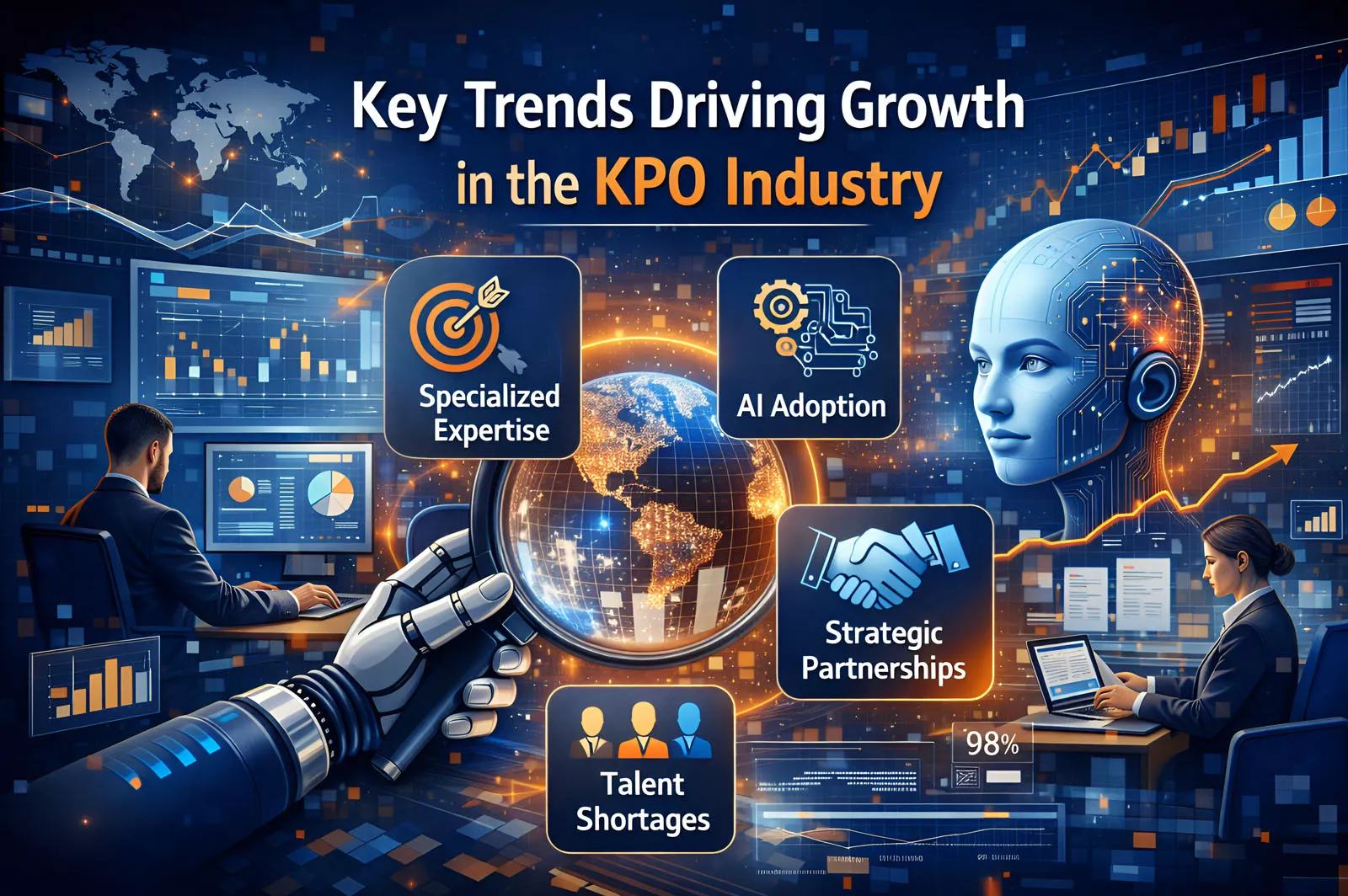
Key Trends Driving Growth in the KPO Industry